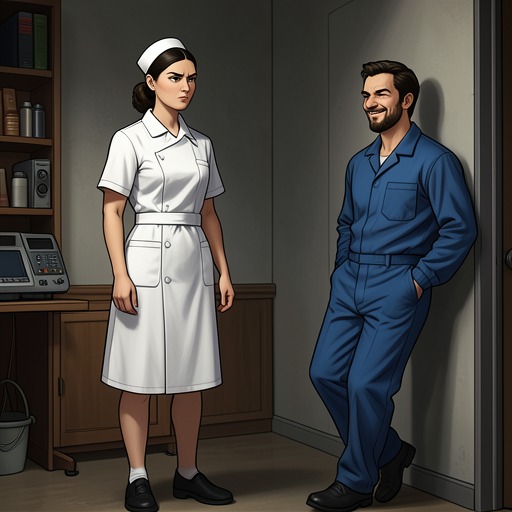
McMurphy and Nurse Ratched's confrontation
One Flew Over the Cuckoo's NestMcMurphy and Nurse Ratched's confrontation is a contest over authority in which seemingly small acts—an admission shower, a song, a vote—reveal how the ward’s rules are enforced and how difficult they are to challenge. McMurphy makes Nurse Ratched’s control visible by refusing to behave as though its terms are natural; she counters by invoking procedure, monitoring his conduct, and treating his anger as evidence to be recorded. Their early mutual appraisal gives way to a more consequential conflict over the patients’ agency and McMurphy’s own freedom.
First Encounter and Competing Claims
When Nurse Ratched summons McMurphy, an aide has reported that he was difficult about taking his admission shower. She acknowledges that he has begun orienting himself with the other patients, but insists that everything must happen in its proper time and that everyone must follow the rules. The exchange makes her authority sound courteous and orderly, even as she uses it to set the terms of his arrival.
McMurphy answers with a wink and a joke about what people say just before he does the opposite. His manner converts a reprimand into a first test of wills: he does not openly accept the nurse’s account of what is required, and he signals that he recognizes the control behind her politeness. The two smile at one another while sizing each other up. Their initial confrontation is not yet a direct struggle, but each already reads the other as an opponent.
The ward’s account of McMurphy’s history sharpens the contrast between them. Nurse Ratched reads that he is thirty-five, has never married, received the Distinguished Service Cross in Korea for leading an escape from a Communist prison camp, and was later dishonorably discharged for insubordination. The record also lists arrests for drunkenness, assault and battery, disturbing the peace, repeated gambling, and statutory rape. It presents him through official categories, while his conduct on the ward quickly unsettles the expectation that he will simply submit to another institution’s rules.
Naming the Ward’s Method
In a group discussion, McMurphy interprets the patients’ treatment as a pecking party: the group’s attention is turned against one of its own, and Nurse Ratched is, in his view, the person who initiates the attack. Dale Harding notes the speed and bluntness of this explanation, but McMurphy’s analogy gives the patients a way to understand their fear as something produced by a social arrangement, rather than as a collection of private weaknesses.
He makes the accusation more pointed by describing Nurse Ratched as a ball-cutter. His argument is that she weakens people at their most vulnerable so they will fall into line, follow her rules, and live as she wants them to. The language is deliberately crude, but the claim is precise: control works by diminishing a person’s confidence and capacity to resist, not merely by issuing instructions. McMurphy’s account recasts the nurse’s authority as an active contest over the patients’ strength.
When Dale Harding describes the possible consequences of open hostility, the conflict’s institutional stakes become concrete. He says that patients labeled potentially assaultive may be sent to the Disturbed Ward, where they lose privileges such as leaving the ward for a Saturday movie or watching television. He also warns of the Shock Shop and the possibility of an operation. McMurphy initially urges the patients to tell Nurse Ratched to go to hell, but Harding’s experience shows why defiance can carry costs beyond a reprimand. In response, McMurphy asks why the patients do not vote, challenging the gap between the ward’s language of democracy and the power the nurse exercises in practice.
Defiance, Performance, and Procedure
McMurphy tries to turn opposition into a wager. He offers five dollars against the patients’ confidence in Nurse Ratched, betting that within a week he can get the better of her without her getting the better of him. The bet makes resistance public and measurable, inviting the patients to stake something on the possibility that her authority can be challenged. The evidence establishes the wager and its terms, not its eventual outcome.
His defiance also takes the form of performance. After getting up early, he sings loudly from the latrine, and Nurse Ratched’s attention is drawn to the disturbance. Later, while standing in his shorts, he is told sweetly to stop showing off and put on his greens. He tips his cap and goes back to the dorm without answering; as Nurse Ratched leaves, his singing starts again. The sequence turns a small disciplinary exchange into a repeated demonstration: she can direct his clothing, but he can resume the noise as soon as she turns away. His songs disrupt the ward’s quiet and make his resistance audible to the others.
The television vote reveals the limits of the patients’ formal power. After McMurphy counts twenty votes, Nurse Ratched points out that forty patients are on the ward. Because only half have voted, she declares the measure defeated and closes the vote, invoking the requirement for a majority to change ward policy. McMurphy objects that the process has been used against them. Rather than answer the substance of his complaint, Nurse Ratched asks the doctor to note that he seems upset and suggests ending the meeting early. The exchange shows how a procedural decision and a clinical description can work together: the vote is closed, while his protest is recast as a symptom to document.
The Cost of Resistance
McMurphy’s opposition changes when he discovers that the other patients have not told him what his defiance may cost him. He says he has learned that they were using him and complains that nobody warned him about the risk of provoking Nurse Ratched. He has found out that openly troubling her could add another year or so to his sentence. His decision to keep clear of her is therefore not a reconciliation; it is a calculation made after learning that the consequences of the contest are not shared equally.
Dale Harding explains the difference: he is voluntary, not committed. He adds that only a few men on the ward are committed, naming McMurphy and Scanlon among them, along with some of the chronic patients. McMurphy asks whether the others have been deceiving him, then walks back and forth in front of the bench, trying to make sense of what he has learned. His surprise exposes a limit in his earlier bravado: he had treated the ward’s rules as a challenge he could choose to take on, without understanding that his own status could keep him there indefinitely.
Meaning of the Confrontation
The conflict is not simply a contest between a rebellious patient and an unyielding nurse. Nurse Ratched controls the ward’s procedures and can frame a patient’s protest as evidence of agitation; McMurphy answers by naming the coercion, drawing the patients into collective acts, and making resistance visible through humor, singing, and calls for a vote. Yet the failed vote and his discovery of the risks attached to commitment show that boldness alone cannot equalize their positions.
That reversal complicates the wager’s promise. McMurphy’s initial confidence invites the patients to imagine that Nurse Ratched can be beaten on her own ground, while the later revelation makes clear that the institution can impose consequences beyond the immediate exchange. Their confrontation thus brings the ward’s central contradiction into focus: it presents participation and treatment as orderly, even democratic, while retaining the power to decide which objections count, which votes matter, and who bears the cost of speaking up.